Anterograde amnesia
Even If This Love Disappears From the World TonightAnterograde amnesia is the central memory condition shaping Maori Hino’s daily life and the novel’s treatment of continuity, independence, and loss. Following an accident, she can experience and remember a day while awake, but when she sleeps, those new memories are erased rather than stored. The condition makes each morning a return to the past, while her notes, relationships, and developing skills offer different ways for experience to endure.
Definition and Daily Cycle
Maori explains that she has anterograde amnesia and forgets everything that happened during the day when she goes to sleep. Tooru Kamiya later learns that brain trauma from the accident has affected the part responsible for storing memories. In the account he receives, memories remain available from waking until sleep, when the brain processes them; instead of being stored, that day’s memories disappear. The next morning, Maori returns to the self she was before the accident.
The novel distinguishes this loss of new memories from the erasure of everything she knows. Tooru’s research explains that anterograde amnesia prevents the formation of new long-term memories but does not mean a person loses all earlier ones. The distinction helps clarify the condition’s specific effect: Maori can take in the present and respond to it, yet cannot reliably carry conscious recollections of that present into the next day.
Records, Routine, and Privacy
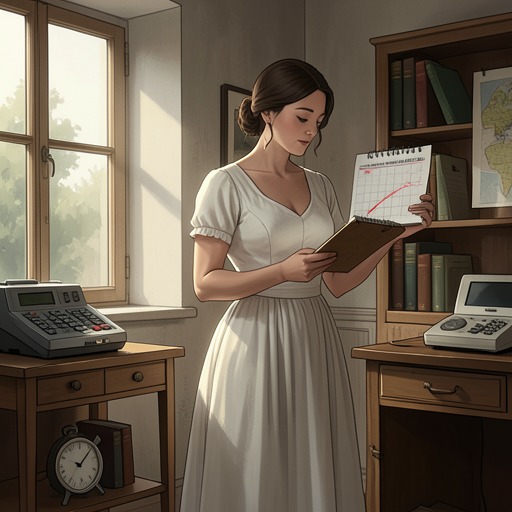
Because experience does not accumulate normally, Maori builds a system for handing information from one day to the next. She uses her phone for notes and photographs, while a tabbed, expandable binder preserves what matters most. Its “Important” section records her accident, her disability, and who knows about it. A separate journal, begun the day after the accident, offers a less formal account of events and includes weekly summaries that let her review her life more quickly.
The records do more than compensate for lost recollection: they shape the routines through which Maori can continue school and manage daily life. She gets up early to read the binder and journal and needs to go to bed by ten. Her mother adjusts her own schedule to hers, remains available for questions, and leaves Maori space to read independently. The journals also show Maori trying to preserve her pre-accident routine so that her classmates will not notice that she is different.
Keeping the condition private is presented as a considered response to risk, not simply as a personal preference. When Maori and her parents consult the school, administrators explain that she can graduate if she attends the required number of days. They also warn that rumors could expose her to unwanted attention: someone who knew she would not remember the previous day might take advantage of that vulnerability, and information could spread beyond the school. The possibility that classmates might be considerate does not guarantee they would keep her condition confidential. Avoiding stress and protecting her mental state therefore become part of how the adults around her understand her needs.
School and the Limits of Accommodation
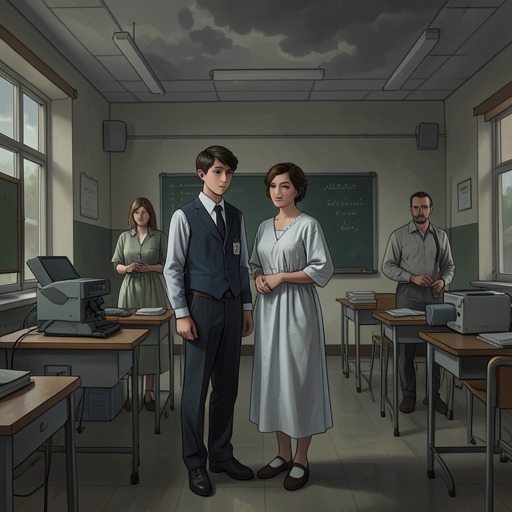
The school’s accommodation lets Maori remain enrolled, but attendance does not restore ordinary participation in learning. Her teachers, including her homeroom teacher, know about her condition and do not call on her. She turns in blank homework and sits for tests even though getting the answers wrong has no practical consequence for her education. She finds the daily discovery that her memory is gone difficult, while the guarantee that attendance can count toward graduation gives her a concrete route to completing high school.
The difference between being present and being able to progress remains unresolved for much of her schooling. She has not yet considered what she will do after graduation, and her earlier effort to enter the advanced class seems meaningless to her in light of her memory loss. Still, she continues attending. In her third year, after the long cycle of exam preparation and changing seasons, Maori, Tooru, and Izumi Wataya all graduate. Her astonishment at staying in school long enough to graduate marks a real achievement, even though it does not erase the educational losses that preceded it.
Skills and Emotional Continuity
The novel presents memory as more than conscious recollection. Tooru’s research distinguishes declarative memory, which can be described as facts or remembered events, from procedural memory, which includes bodily skills such as riding a bicycle. That distinction offers a different kind of persistence: a person may lose the memory of a particular day without losing what the body has learned through practice.
Drawing becomes an important example. Maori had stopped making art when she began high school, but during summer vacation she starts drawing again and practices every day. Her earlier selves have reasoned that procedural memory might let her improve even when she cannot preserve daily experiences as memories. When she sketches from a film, she concentrates on the sensations of drawing rather than consciously planning each mark. Her lines grow more confident, and she recognizes that the skill embodied in them is evidence of accumulated effort. The condition limits her autobiographical memory, but it does not prevent every form of learning or development.
Emotional responses and sensory cues also complicate the idea that forgetting is total. Watching a video of a bicycle ride, Maori recognizes that the happiness on screen belongs to a past version of herself, and feels a longing for that self even without being able to recall the experience. Later, hearing audio extracted from a video brings back the circumstances of the ride: she remembers that it was the day she insisted that she and Tooru ride together. When Izumi recounts an earlier aquarium visit and its familiar tea, she explains that smell can be connected to the hippocampus and may evoke memories. Such moments do not make recollection dependable, but they show how sound, scent, and emotion can approach what ordinary conscious memory has lost.
Recovery and Narrative Significance
The condition lasts for about three years, beginning at the end of April in Maori’s second year of high school. She later learns that there have been other cases but no cure, and that recovery depends on the body’s natural healing. About three months before she recounts this, in April, she recovers. She can now remember what happened the previous day, a change that makes the former daily reset newly legible: graduation had already shown her that a future remained possible, but recovery allows that future to include a continuous recollection of events.
Anterograde amnesia governs the novel’s form as well as Maori’s circumstances. The binder and journal repeatedly provide her with information that readers have seen accumulate, creating a contrast between the continuity of the written record and the discontinuity of her lived recollection. Yet the condition does not reduce Maori to someone acted upon or awaiting a cure. She chooses routines, weighs the risks of disclosure, maintains relationships, returns to drawing, and completes school. By setting fragile autobiographical memory beside records, bodily skill, and sensory traces, the novel portrays continuity as something that can be supported and rebuilt even when it cannot be taken for granted.